Use a Continuous Fourier Series to Approximate the Sawtooth Wave
Theory
- Theory
- Examples
Theory
This section gives a brief introduction to Fourier Series representation of signals as relevant to the Fourier Series demo. Towards the end, Fourier series representation for those signals used in the tool are derived as examples.
What is Fourier series representation and why do we need it ? The analysis of LTI (Linear Time Invariant) systems can be made easier if we can represent different signals using some basic set of signals. Fourier Series is one kind of representation of signals, where we use complex exponentials. These basic signals can be used to construct more useful class of signals using Fourier Series representation. Fourier Series can be used to represent both continuous and discrete Periodic signals.
Fourier Series representation of Continuous time periodic signal
There are two well known basic periodic signals, the sinusoidal signal 

x(t) = x(t+T) Associated with this signal are other harmonic complex exponentials, given as 


For real signals we have,


Fourier Series coefficients
If a periodic signal can be represented in the form shown in Eqn(1.1), then we need to have a way to determine the coefficients ak . These are called the Fourier coefficients. The steps in deriving the equation to determine the coefficients are shown below.
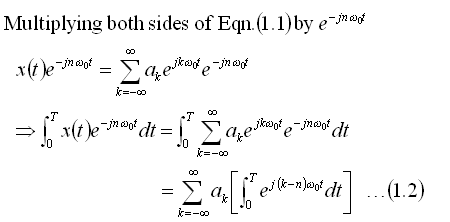

In summary, the Fourier Series for a periodic continuous-time signal can be described using the two equations

[Back to Top]
Examples
This section shows the steps in deriving the Fourier series coefficients for the signals used in the Fourier Series demo. While the first case has detailed steps, for the rest few intermediate steps and the final form is provided. Now lets look at the different type of signals.
- Square wave
- Triangle wave
- Ramp or Sawtooth wave
- Full-wave Sine
- Half-wave Sine
Square wave
Here we consider the original signal to be a periodic continuous Square wave and derive its Fourier Series coefficients. The steps involved are as shown below. We start with the functional form of the original square wave, 


Xk is -p/2, while for k > 0, Xk is p/2. 
[Back to Examples]
Triangle wave
Here we consider the original signal to be a periodic continuous Triangle wave and derive its Fourier Series coefficients. The detailed steps are not shown below. We start with the functional form of the original triangle wave, 


[Back to Examples]
Ramp or Sawtooth wave
Here we consider the original signal to be a Ramp or sawtooth wave and look at the steps involved in deriving its Fourier Series coefficients. We start with the functional form of the ramp used in the demo, 

[Back to Examples]
Full-wave
Here we consider the original signal to be a full-wave rectified sine wave and look at the steps involved in deriving its Fourier Series coefficients. We start with the functional form of the full-wave used in the demo, 

[Back to Examples]
Half-wave
Here we consider the original signal to be a half-wave rectified sine wave and look at the steps involved in deriving its Fourier Series coefficients. We start with the functional form of the half-wave used in the demo, 

[Back to Examples]
Does it all make sense to you? If you are not sure go over it one more time before moving on with the rest of the tutorial.
If you still do not get it, let us know what is confusing you. We want to make this tutorial understandable and any feedback is appreciated!
[Back to Top]
Source: https://www.utdallas.edu/~raja1/EE%203302%20Fall%2016/GaTech/fseriesdemo/help/theory.html
0 Response to "Use a Continuous Fourier Series to Approximate the Sawtooth Wave"
Post a Comment